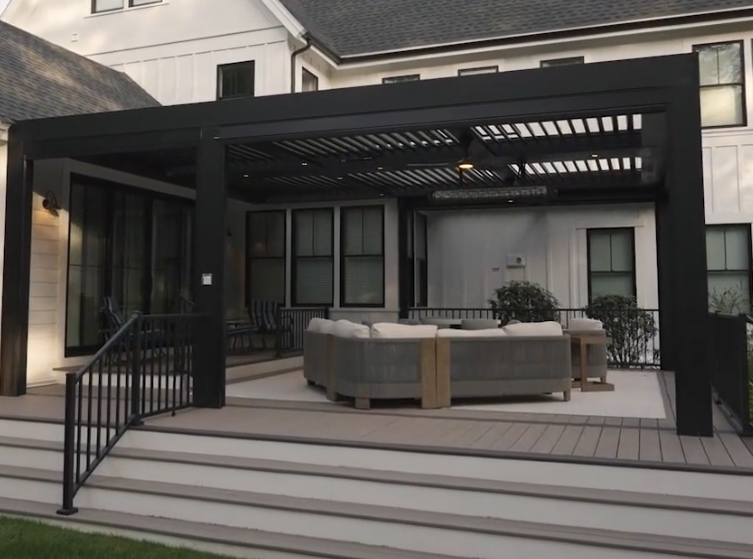
For most Florida Panhandle homes, a louvered pergola is the better choice, because its adjustable louvers let you control sunlight, shade, airflow, and rain protection from a single structure. A fixed pergola delivers steady filtered shade and a classic look at a lower upfront cost, but it cannot close during a downpour or open up on a cool morning. If you want to use your patio through the full Florida year instead of only on mild, dry days, that adaptability is what separates the two.
At Panhandle Outdoor Solutions, we install motorized louvered pergolas from StruXure across Panama City, Panama City Beach, Destin, Santa Rosa Beach, 30-A, Pensacola, and Tallahassee. Here is how the two styles compare so you can decide which suits your home, your budget, and the way you actually live outdoors.
Louvered vs Fixed Pergolas: Quick Comparison
| Consideration | Louvered Pergola | Fixed Pergola |
| Shade control | Louvers pivot for full sun, filtered light, or full shade | Permanent beams cast one fixed shade pattern |
| Rain protection | Louvers close to shed water off the structure | Limited, open beams let rain through |
| Airflow | Adjustable, you set ventilation as conditions change | Passive, depends on beam spacing and placement |
| Technology | Motorized control, rain and wind sensors, smart home integration | None, fully manual structure |
| Upfront cost | Higher, reflects the mechanics and automation | Lower, simpler build |
| Upkeep | Periodic cleaning plus occasional service of moving parts | Minimal on aluminum, higher on wood |
How Each Type Handles Florida Sun, Rain, and Wind
Panhandle weather rarely holds still. A morning that starts clear can turn into a Gulf storm by mid-afternoon, and the humidity sits on top of everything in between. That is the real test for any patio cover.
A louvered pergola is built for that pattern. Open the louvers for morning sun, tilt them to cut the midday glare while keeping a breeze moving, then close them when a shower rolls through so your furniture and your guests stay dry. Our Pergola X systems rotate the louvers up to 170 degrees, so you are adjusting light and ventilation with real precision rather than choosing between shade and no shade.
Automation removes the guesswork. Rain sensors close the louvers on their own when a storm arrives, which matters when nobody is home. Wind sensors open the louvers when gusts reach 60 mph so air passes through the system instead of pushing against it, reducing uplift during heavy weather.
A fixed pergola takes the opposite approach. With no moving parts, there is nothing to service and nothing to jam. It handles wind well and gives dependable relief from direct sun. What it cannot do is shut out rain or adjust as the sun moves, so patio furniture, cushions, and rugs usually need covers or need to be moved. Along the coast, wood versions also face salt air, humidity, and UV exposure that lead to sealing, staining, and eventual replacement.
Design and Architectural Appeal
Both styles can look excellent. They simply speak to different tastes.
When a louvered pergola fits best
Louvered systems suit homes with clean lines and owners who want the structure to do something, not just sit there. Pergola X is built from extruded aluminum with marine grade components that resist corrosion, warping, rust, UV degradation, and wind uplift, and it comes in six standard colors plus thousands of custom colors and woodgrain finishes. Corbel ends, cornices, column wraps, caps, and bases let the structure echo your home instead of fighting it, and an integrated 360 degree gutter system keeps runoff managed and out of sight.
Add fans, lighting, heaters, or motorized screens and the space becomes usable morning through evening. Optional MyLink control connects the system to Alexa, Google Assistant, Crestron, Control4, Savant, and other platforms, or you can operate it from a remote, a wireless wall switch, or your phone.
When a fixed pergola fits best
If your home leans traditional, Mediterranean, or coastal cottage, a fixed structure with wood or whitewashed finishes can be the more natural companion. It reads as timeless, it costs less to build, and it asks almost nothing of you once it is up. For a shaded seating area, a walkway, or a garden feature where rain protection is not the point, that simplicity is a genuine strength.
Worth knowing: a fixed roof does not have to mean a wood frame. The Pan6 model in the Pergola X line gives you continuous cover with the look of a pergola, built in the same aluminum system, so you can have permanence without the maintenance that comes with timber on the Gulf Coast.
Cost, Installation, and Long-Term Ownership
Louvered pergolas cost more upfront. The motors, sensors, engineered aluminum, and professional installation all sit behind that number, and pricing moves with size, model, finish, and the add-ons you choose. Fixed pergolas are cheaper to build because there is less to build, which is why they appeal to homeowners taking a do it yourself approach, though structural safety in a hurricane zone is not a good place to test your carpentry.
The more useful comparison is total ownership. A louvered system needs an occasional rinse and a periodic check of the moving parts. A fixed wood pergola needs regular sealing or staining and will eventually need boards replaced. Add in the cushions, rugs, and outdoor furniture that a fixed pergola cannot protect from rain and sun, and the gap narrows over time.
Every Pergola X install is backed by StruXure’s transferable limited warranty on structural components and movable accessories, plus a lifetime warranty against manufacturer defects in materials. Permits are part of our process rather than your problem, and we help identify and address permit requirements before installation begins. Financing is available if you would rather build now and pay over time.
Our process is straightforward: a free on-site design consultation, a detailed 3D rendering with a transparent quote, installation by our own trained crews following local codes, then ongoing support for maintenance, upgrades, and warranty questions.
Everyday Comfort and Environmental Control
The practical difference shows up in how often you actually go outside.
On a hot August afternoon, angling the louvers creates shade while still letting air move, which keeps the space usable instead of stifling. On a cool winter morning, opening them lets in warmth without the wind. Close them during an evening shower and dinner keeps going. Pair the pergola with MagnaTrack motorized retractable screens and you add insect control, privacy, and protection from driving rain without giving up the view.
That control extends indoors too. Shading the windows and doors along your patio reduces the direct sun hitting that side of the house during the hottest part of the day, which takes some load off your air conditioning.
For a fully enclosed version of the same idea, our Cabana X installations create a private room outdoors that works as a yoga space, a dining room, or a poolside retreat, protected from the elements while still feeling open.
Which Pergola Is Better for the Florida Panhandle Climate?
If you entertain often, own outdoor furniture you want to keep, or simply want your patio available year round, a motorized louvered pergola is the stronger investment. It answers the specific problems this region creates: intense sun, sudden rain, salty air, and high wind.
If you want a shaded architectural feature at a lower cost, you are comfortable with shade only, and you accept the upkeep that coastal weather demands, a fixed pergola remains a reasonable choice.
For most of the homeowners we work with in Destin, 30-A, Panama City Beach, and Pensacola, the deciding factor is not the structure itself. It is how many more days a year they end up outside.
Ready to See What Your Space Could Look Like?
We would rather show you than sell you. Book a free design consultation and we will visit your property, take measurements, talk through models and finishes, and prepare a 3D rendering with a transparent quote, with no pressure and no obligation.
Call us at 850-819-8451, request your free consultation online, or visit us at 3414 Country Club Ct, Lynn Haven, FL 32444. Ask about financing if you want to build now and pay over time.
Frequently Asked Questions
Are louvered pergolas more expensive than fixed pergolas?
Yes, louvered pergolas cost more upfront because of the motorized louvers, sensors, engineered aluminum, and professional installation involved. Final pricing depends on size, model, finish, and add-ons such as lighting, fans, heaters, or screens. Fixed pergolas are less expensive to build but may cost more over time in sealing, staining, board replacement, and furniture protection. We provide a transparent quote after a free on-site consultation, and financing is available.
Do louvered pergolas hold up in Florida hurricanes and high winds?
Pergola X is built from extruded aluminum with marine grade components that resist corrosion, rust, UV degradation, and wind uplift. Wind sensors automatically open the louvers when gusts reach 60 mph, letting air pass through the structure rather than pressing against a closed roof, which reduces uplift. Structures are installed to meet local codes for our coastal market.
Do I need a permit for a pergola in the Florida Panhandle?
Permit and zoning requirements vary by city and county, and structural additions often require one. We identify and address permit requirements as part of the project before installation begins, so you are not left to work through it alone. HOA approval may also apply in some neighborhoods, and we can help with the documentation those boards typically ask for.
How much maintenance does a louvered pergola need in a coastal climate?
Not much. Rinse the structure periodically to clear salt and debris, keep the louver channels clear, and have the moving parts checked occasionally so everything continues to operate smoothly. The aluminum frame and finishes resist rust, rot, and corrosion, which is a meaningful advantage over wood this close to the Gulf.
Can a louvered pergola keep rain out completely?
When the louvers close, they form a solid surface that sheds water off the structure, and the integrated 360 degree gutter system channels runoff away. Rain sensors close the louvers automatically when a storm starts. For wind-driven rain coming in from the sides, pairing the pergola with retractable motorized screens is the better solution.
Which pergola suits a traditional or coastal cottage style home?
A fixed pergola in wood or a whitewashed finish is the classic match, and it works well for garden features and shaded walkways. If you like that look but want less upkeep and the option of rain protection, the Pan6 model gives you a continuous fixed roof in the same aluminum system, and louvered models are available in woodgrain finishes and thousands of custom colors.
How long does a louvered pergola installation take?
Installation time depends on size, complexity, and site preparation, but most residential projects are completed in a few days once permitting and materials are in place. We walk you through the schedule during the design phase so you know what to expect before work starts.
Can I add fans, lighting, heaters, or screens later?
Yes. Fans, lighting, heaters, and motorized screens are available as add-ons and are commonly specified during design. Bringing them up at the consultation stage is easier, since wiring and mounting can be planned into the build rather than retrofitted afterward.